materials · Aug 18, 2026
Redwood and Salt Air
Timber on the coast does not stay the colour you chose. What salt, wind and sun do to redwood siding over ten years, and how we design so that change is welcome.
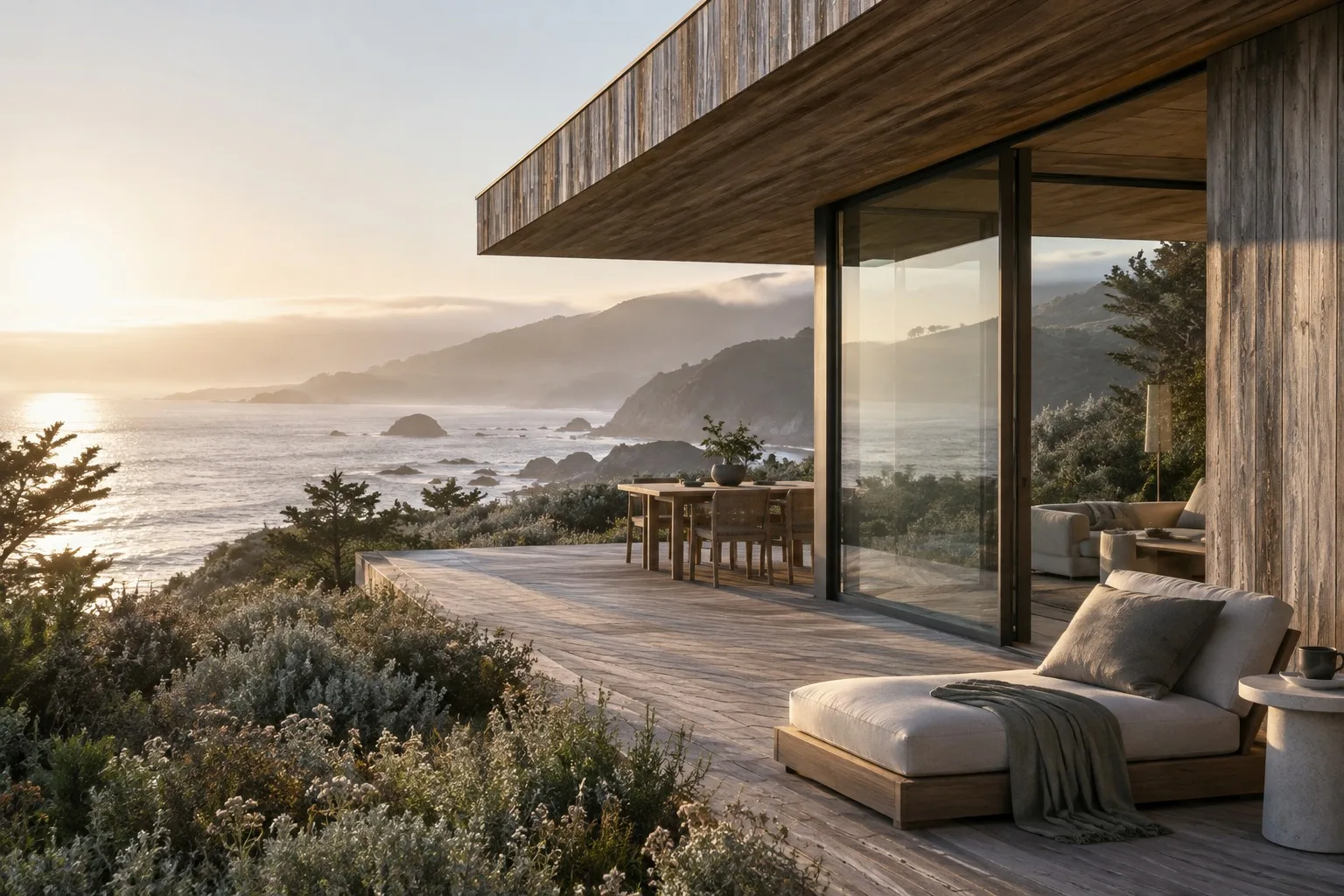
A client once held up a fresh board of redwood, glowing the colour of cinnamon, and asked if we could make it stay that way. I told her the truth: not for long, and I wouldn't want to.
Wood by the sea is a conversation. The wind lays salt on it. The sun draws out the pigment. Rain washes the surface and the grain lifts, and within two or three years the warm red turns to a soft, silvery grey. It is the colour of driftwood and old docks. We have come to think of it as the finished colour.
Why redwood
We reach for redwood on the coast for one sound reason: it is a timber that ages without fuss. The heartwood carries natural compounds that help it resist rot and insects, which is why you still see old redwood decks and fences standing in damp places long after other wood would have given up. It also tends to move less than many softwoods, so boards stay flat rather than cupping.
It is not cheap and not always available, so we are particular. Wherever possible we use reclaimed stock, salvaged from old water tanks, barns and fencing. The salvaged board has already weathered once, and it carries a depth that new timber takes years to earn.
How it ages
Over the first year, expect a patchy, uneven tone. South and west walls silver first. North walls, in shade, may darken and grow a faint green bloom in damp seasons. Under a deep eave, the board stays warm for much longer than it does at the gable. Instead of fighting that, we design for it. A house that is silver in the sun and amber in the shade is a house with a face.
We never finish the timber with a heavy film. A clear coating peels and has to be stripped. An open-pored oil lets the wood breathe, and the weathering happens evenly. For clients who insist on the original warmth, we can refresh the colour every few years with a light treatment, but I always say: wait one winter before deciding.
Details that do the real work
Weathering is only graceful when water can leave. The design matters more than the species.
Rainscreen cladding. The boards are fixed over a ventilated gap, so air moves behind the siding and moisture dries from both sides.
Deep eaves. They shield the walls from the worst of the rain and the highest sun.
Stainless fixings. Ordinary steel stains the timber and corrodes in salt air within a couple of seasons.
Raised bases. Nothing wooden touches the ground or splash zone.
Living with it
Every coastal house needs washing once or twice a year. A soft brush and fresh water, no pressure hose. Take off the salt, check the corners, and look for anything holding damp. Fifteen minutes and a cup of tea.
What we are asking of clients is not patience but a little curiosity. Watch your house change. By the tenth winter, the cladding will look as though it has always belonged to the shoreline. For how we approach the structure beneath it, see Notes on a Cantilevered House.
No comments yet
Comments are open. Have a thought or a question? Share it below.